New Lab Analytics Dashboards, With Options for Every Plan
New Analytics dashboards in Confident LIMS: turnaround time, test-result trends, client activity, benchmarks, unpaid order balances. Options on every plan.
READ MORE
Cannabis testing labs must meet ISO/IEC 17025, METRC or BioTrack integration, and strict chain-of-custody rules in 2026. Learn how to stay compliant.

Updated 03/20/2026
Regulators in New York, California, and Illinois have intensified oversight of cannabis testing laboratories. State agencies conduct unannounced inspections, audit chain-of-custody documentation, and verify track-and-trace system integration. Laboratories that view compliance as a burden risk license suspension. Those that treat compliance as strategic advantage through automated reporting and audit-ready records win trust from state agencies and cannabis manufacturers.
Cannabis testing laboratories face compliance requirements that general analytical laboratories do not encounter. State track-and-trace systems require real-time data integration. Regulatory agencies mandate specific COA formatting and reporting timelines. ISO/IEC 17025 accreditation demands comprehensive quality management systems. Manual compliance processes introduce errors that trigger regulatory findings and jeopardize laboratory licenses.
Confident LIMS automates compliance workflows that cannabis testing laboratories require: direct integration with state track-and-trace systems including METRC and BioTrack, automated chain-of-custody documentation with electronic timestamps, state-specific COA generation meeting regulatory formatting requirements, and audit trail maintenance satisfying 21 CFR Part 11 standards. These capabilities position laboratories for regulatory success while competitors like Benchling, LabVantage, and CloudLIMS struggle with manual compliance processes.
🎧 Prefer to listen? Here’s the audio version of this article:
New York Office of Cannabis Management mandates that all licensed laboratories integrate with the state METRC track-and-trace system. Laboratories must receive packages via METRC, assign sample identifiers, enter test results, and create shipping manifests back to cannabis manufacturers within state-mandated timeframes.
METRC is New York's official seed-to-sale system. Laboratories must report sample receipt, testing status, and disposal through METRC. Manual data entry consumes 2-3 hours daily per technician and introduces errors when package identifiers are transcribed incorrectly.
Confident LIMS integrates directly with New York METRC through API connections that automatically transmit sample receipt data, testing progress updates, and final results. Technicians scan package barcodes during accessioning. The system logs METRC identifiers, links them to laboratory sample numbers, and pushes status updates automatically. Manual data entry is eliminated and state reporting compliance is ensured.
New York requires ISO/IEC 17025 accreditation for cannabis testing scope. Laboratories must maintain current certificates, document proficiency testing participation, and demonstrate ongoing method validation. Regulations also require detailed chain-of-custody records from sample receipt through disposal.
Confident LIMS maintains accreditation documentation automatically through method validation record storage, proficiency testing tracking, and quality control monitoring with automated alerts. Chain-of-custody documentation occurs through barcode scanning that records every sample movement with electronic timestamps and user authentication.
Resources: NY Office of Cannabis Management | METRC New York Help Site | ISO/IEC 17025 Documentation
California Department of Cannabis Control requires testing laboratories to operate under the state METRC system and meet stringent quality control rules. California regulations are among the most comprehensive in the United States and include specific method validation requirements, COA formatting standards, and reporting timelines.
Laboratories must log sample receipt, testing batch assignments, and completed results in California METRC. Incomplete or late uploads trigger disciplinary actions including compliance notices, financial penalties, and potential license suspension. Cannabis manufacturers cannot release product until results appear in state systems.
Confident LIMS eliminates California METRC reporting delays through automated data transmission within seconds of quality assurance approval. The system generates state-compliant COAs, extracts required data fields, and transmits information to METRC without manual intervention.
California DCC requires laboratories to validate each analytical method according to state guidelines and maintain version-controlled standard operating procedures. Quality control samples must run at specified frequencies with documented corrective actions for any failed runs.
Confident LIMS centralizes method validation records with version control, tracks SOP revisions with electronic signatures, automates QC sample scheduling based on state-mandated frequencies, and generates real-time control charts showing analytical performance trends.
Resources: California Department of Cannabis Control Laboratory Regulations | California METRC Help Site | ISO/IEC 17025 Documentation
Illinois mandates cannabis testing laboratories use BioTrack for seed-to-sale tracking and follow regulations issued by Illinois Department of Agriculture and Department of Public Health. Illinois regulations differ from California and New York in specific reporting requirements and quality control expectations.
BioTrack is Illinois' official track-and-trace system. Laboratories must assign sample identifiers, log chain-of-custody entries, and submit Certificates of Analysis through BioTrack. Illinois also requires state licenses from IDOA and ISO/IEC 17025 accreditation for cannabis testing scope.
Confident LIMS integrates with Illinois BioTrack through API connections that automate sample receipt reporting, testing status updates, and COA submission. The system handles BioTrack-specific data formatting requirements and maintains accreditation scope documentation.
Illinois requires methods to be validated and submitted to IDOA. Laboratories must maintain validation reports and proficiency testing records. Test results must be reported to both cannabis manufacturers and the state. Laboratories must retain records for minimum five years.
Confident LIMS automates record retention through cloud-based storage with unlimited retention periods, automated backup procedures, and searchable archives that enable rapid record retrieval during regulatory inspections.
Resources: Illinois BioTrack Seed-to-Sale Tracking | Illinois Department of Agriculture Testing Lab Requirements | ISO/IEC 17025 Documentation
Evaluate compliance readiness for 2026:
Track-and-Trace Integration
ISO/IEC 17025 Accreditation
Chain-of-Custody Documentation
Method Validation and Quality Control
Reporting and Recordkeeping
If you cannot check all requirements, your laboratory faces compliance risk that could result in regulatory findings, license suspension, or operational shutdown. Modern LIMS platforms designed specifically for cannabis testing eliminate these risks through automated compliance workflows.
General LIMS platforms like Benchling, LabVantage, CloudLIMS, and LabWare provide basic laboratory functionality but do not address cannabis testing regulatory requirements. These platforms lack state track-and-trace system integration, automated compliance documentation, and cannabis-specific workflow automation.
Confident LIMS is purpose-built for cannabis testing laboratories:
What happens if laboratories fail state compliance requirements?
State agencies issue compliance notices for minor violations, financial penalties for repeated violations, and license suspensions for severe non-conformances. License suspension halts operations until corrective actions are verified—costing laboratories $50,000-$100,000 in lost revenue.
How often do regulatory inspections occur?
State cannabis regulatory agencies conduct annual routine inspections and additional for-cause inspections when compliance concerns arise. ISO/IEC 17025 accreditation bodies conduct annual assessments. Laboratories should maintain audit-ready documentation continuously.
Can laboratories operate in multiple states with different track-and-trace systems?
Yes. Confident LIMS supports multiple state track-and-trace systems simultaneously. Laboratories operating in California, Colorado, New York, and Illinois manage all state reporting through a single LIMS platform.
What is the cost of compliance violations?
Financial penalties range from $1,000-$10,000 per violation. License suspension costs laboratories $50,000-$100,000 in lost revenue during forced operational shutdown. Corrective action documentation consumes 20-30 hours of quality assurance staff time per violation.
How long does LIMS implementation take?
Confident LIMS implementation for cannabis testing laboratories typically completes within 6-8 weeks including state track-and-trace system integration, workflow configuration, and staff training.
Cannabis regulations continue evolving toward greater transparency, faster reporting requirements, and enhanced traceability. Laboratories that adopt modern LIMS platforms with built-in track-and-trace integration, automated chain-of-custody documentation, and comprehensive audit trail generation position themselves for regulatory success.
Confident LIMS provides cannabis testing laboratories with compliance automation that general LIMS platforms do not deliver. State-specific track-and-trace integration, automated COA generation, electronic chain-of-custody documentation, and 21 CFR Part 11 audit trails eliminate manual processes that introduce errors and create regulatory risk.
Investing in compliance infrastructure today protects laboratory licenses, strengthens relationships with regulatory agencies, and positions laboratories as trusted partners for cannabis manufacturers operating under strict state oversight.
Interested in seeing how compliance-focused LIMS can streamline your operations and eliminate regulatory risk?
Book a demo and we will show you how Confident LIMS supports cannabis testing laboratories in New York, California, Illinois, and beyond.
Let's share!
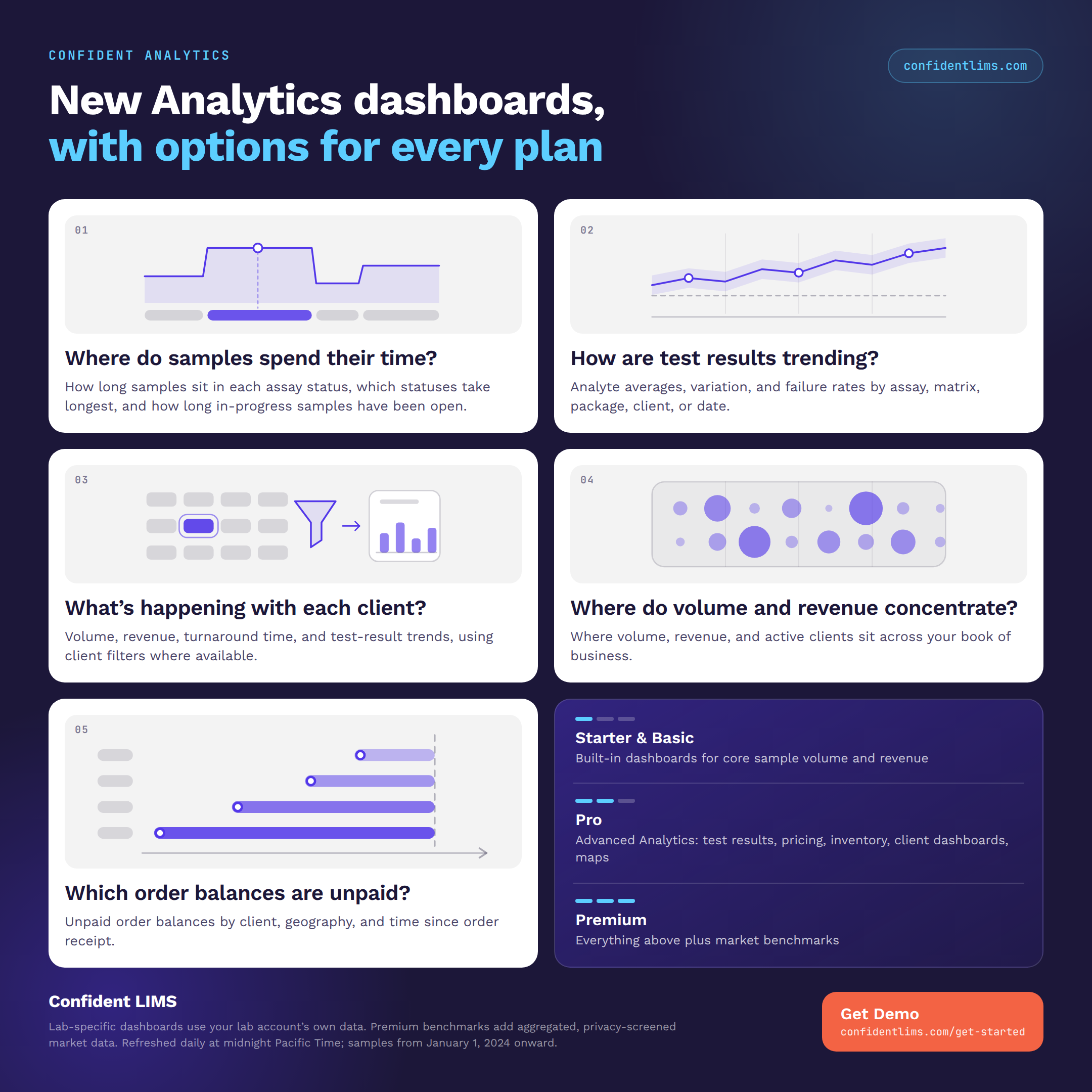
New Analytics dashboards in Confident LIMS: turnaround time, test-result trends, client activity, benchmarks, unpaid order balances. Options on every plan.
READ MORE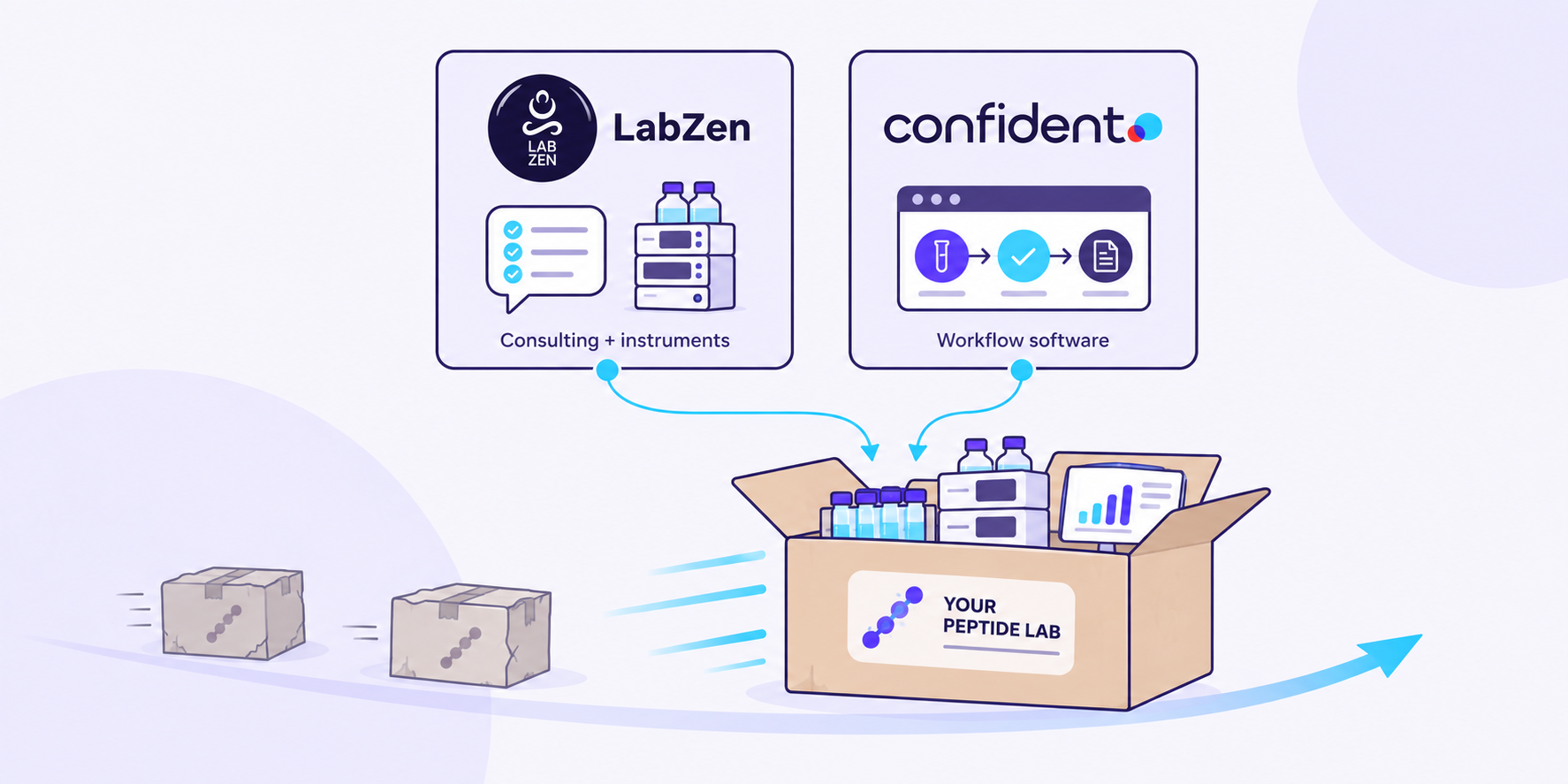
Confident LIMS and Lab Zen are partnering to help peptide labs plan instruments, methods, and the sample-to-COA workflow together.
READ MORE
Analytics dashboards are now live in the Confident Client Portal: free Volume dashboards for everyone, plus 19 advanced dashboards for Client Pro.
READ MORE


