New Lab Analytics Dashboards, With Options for Every Plan
New Analytics dashboards in Confident LIMS: turnaround time, test-result trends, client activity, benchmarks, unpaid order balances. Options on every plan.
READ MORE
Peptide testing demand is rising fast. See what a peptide testing lab must confirm — identity, purity, quantity — and what a configurable LIMS needs to keep up.
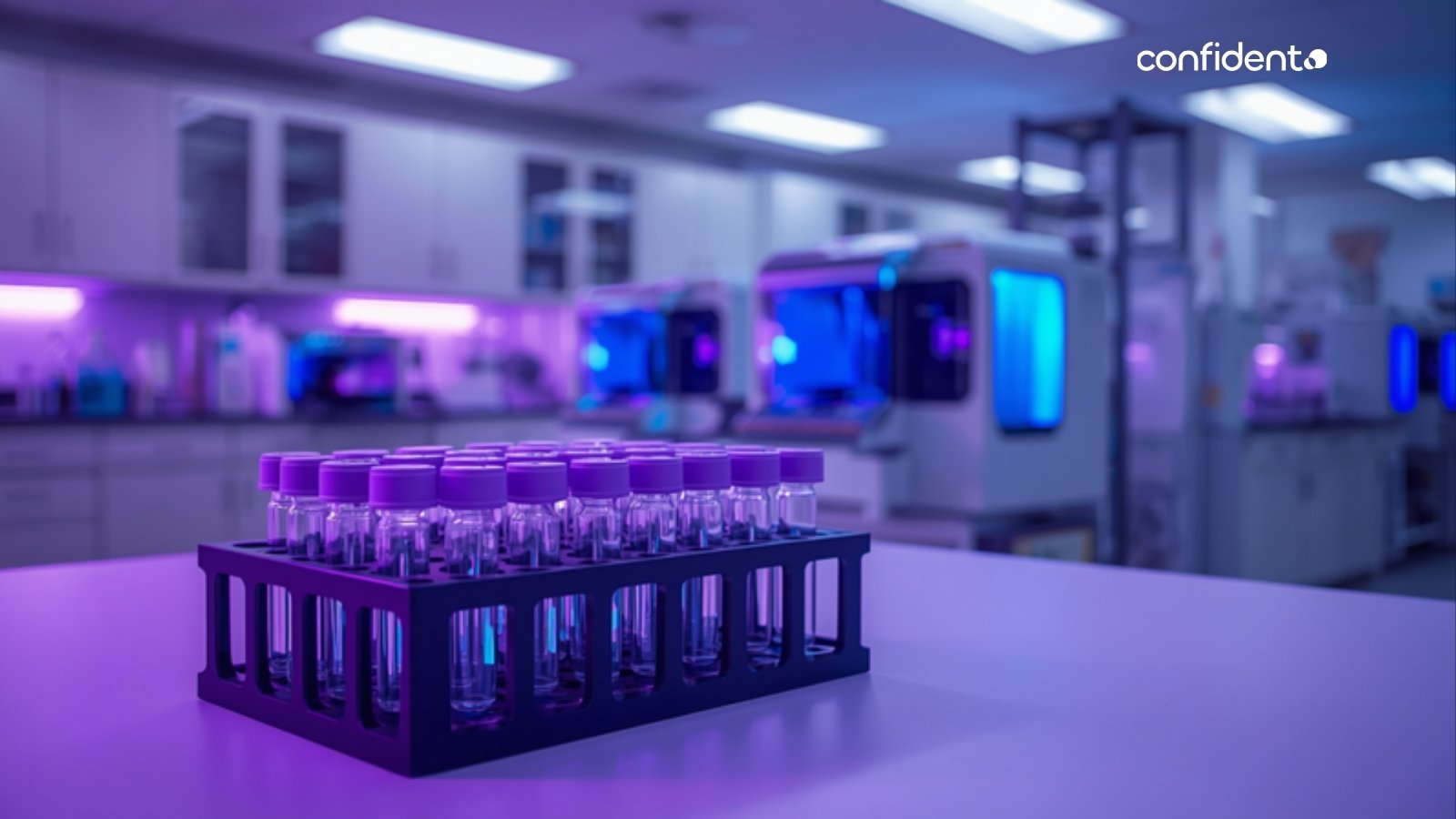

Peptide testing is one of the fastest-moving corners of analytical lab work right now — and the labs winning that work are the ones whose operations can keep pace. More samples, more scrutiny, more clients asking for proof. For most labs the science is the manageable part. The bottleneck is everything around the science.
🎧 Prefer to listen? Here's the full audio version of this article:
A peptide testing lab has to confirm three things about every sample: its identity (is it the peptide it claims to be?), its purity (what else is in there?), and its quantity (is the dose right?). Doing that at volume — with a traceable record and a defensible Certificate of Analysis (COA) behind every result — is where a Laboratory Information Management System (LIMS) earns its keep.
Three markets are converging at once. GLP-1 weight-loss therapies have pulled peptides into the mainstream. Wellness and anti-aging products keep expanding the category. And research-use peptides continue to generate testing volume of their own.
Regulatory attention is rising alongside that demand. An FDA advisory committee is scheduled to review several peptides on July 23–24, 2026, weighing how some research peptides should be handled going forward. At the same time, regulators have moved to tighten limits on large-scale compounded GLP-1 products.
Whichever way specific rules land, the direction of travel is the same: more eyes on purity, identity, and safety. That raises the bar for independent, third-party testing — and for the documentation that stands behind every result.
Most peptide quality failures fall into the same three buckets. A good lab is built to answer all three, every time.
Is the sample actually the peptide on the label? Identity testing confirms the molecule's structure and sequence, typically with mass spectrometry (MS) and high-performance liquid chromatography (HPLC). Get this wrong and nothing downstream matters.
What else is in the vial? Purity testing measures the target peptide against related impurities and contaminants. It's where labs spend much of their analytical time, and where clients increasingly expect a clear, itemized answer.
Is the stated amount the actual amount? Quantity — or content — testing confirms the dose. For products people rely on, a result that's off here is the one that gets noticed.
Each of these produces data that has to be captured, reviewed, and reported without drift. That's an operations problem as much as a chemistry one.
Plenty of labs start with spreadsheets. They work — until the volume arrives.
Once samples climb, a spreadsheet can't enforce chain of custody, can't lock a result after review, and can't tell you who changed what and when. Every manual hand-off between a worklist, an instrument, and a COA is a place for a sample ID to get mistyped or a result to land in the wrong record. And when a client or an auditor asks for the full history of one batch, you're reconstructing it by hand.
Not ideal — especially in a category where the questions about quality are getting louder, not quieter.
Confident is a configurable LIMS for peptide testing labs (among other nutraceutical testing), and it runs the full workflow. A LIMS built for high-throughput analytical work takes the operational weight off the bench so the science can move. For peptide labs, a few capabilities matter most:
The word that matters here is configurable. You adjust the system to match your workflow without writing code or waiting on a developer — the building blocks rearrange, they don't break. The workflow — intake, identity, purity, quantity, COA — is one Confident is already built to run.
What does a peptide testing lab actually test for? Three things: identity (is it the right peptide?), purity (what else is present?), and quantity (is the dose correct?). These are typically confirmed with HPLC and mass spectrometry, then reported on a Certificate of Analysis.
How do peptide labs deliver results to clients? Through a Certificate of Analysis (COA) — a report summarizing identity, purity, and quantity results for a sample. A LIMS with a Client Portal lets labs deliver COAs directly instead of emailing PDFs.
Why are peptides under more regulatory attention? Fast growth across GLP-1, wellness, and research-use peptides has drawn focus to purity, identity, and safety. An FDA advisory committee is reviewing several peptides in July 2026, and regulators have tightened limits on large-scale compounded GLP-1s.
Can one LIMS handle peptide testing alongside other testing services? Yes. A configurable LIMS runs multiple verticals from one account, with test packages, COA templates, and workflows that adapt to each sample's industry — so a lab can add peptide or nutraceutical testing without a second system.
🎧 Short on time? Here's the podcast brief:
Peptide testing isn't slowing down, and the labs that win it will be the ones whose operations are ready before the volume hits — not scrambling after. Clean intake, traceable workflows, and COAs your clients can trust are what turn a busy lab into a defensible one.
See how Confident supports high-throughput analytical testing from sample login to final report. Get Demo.
Let's share!
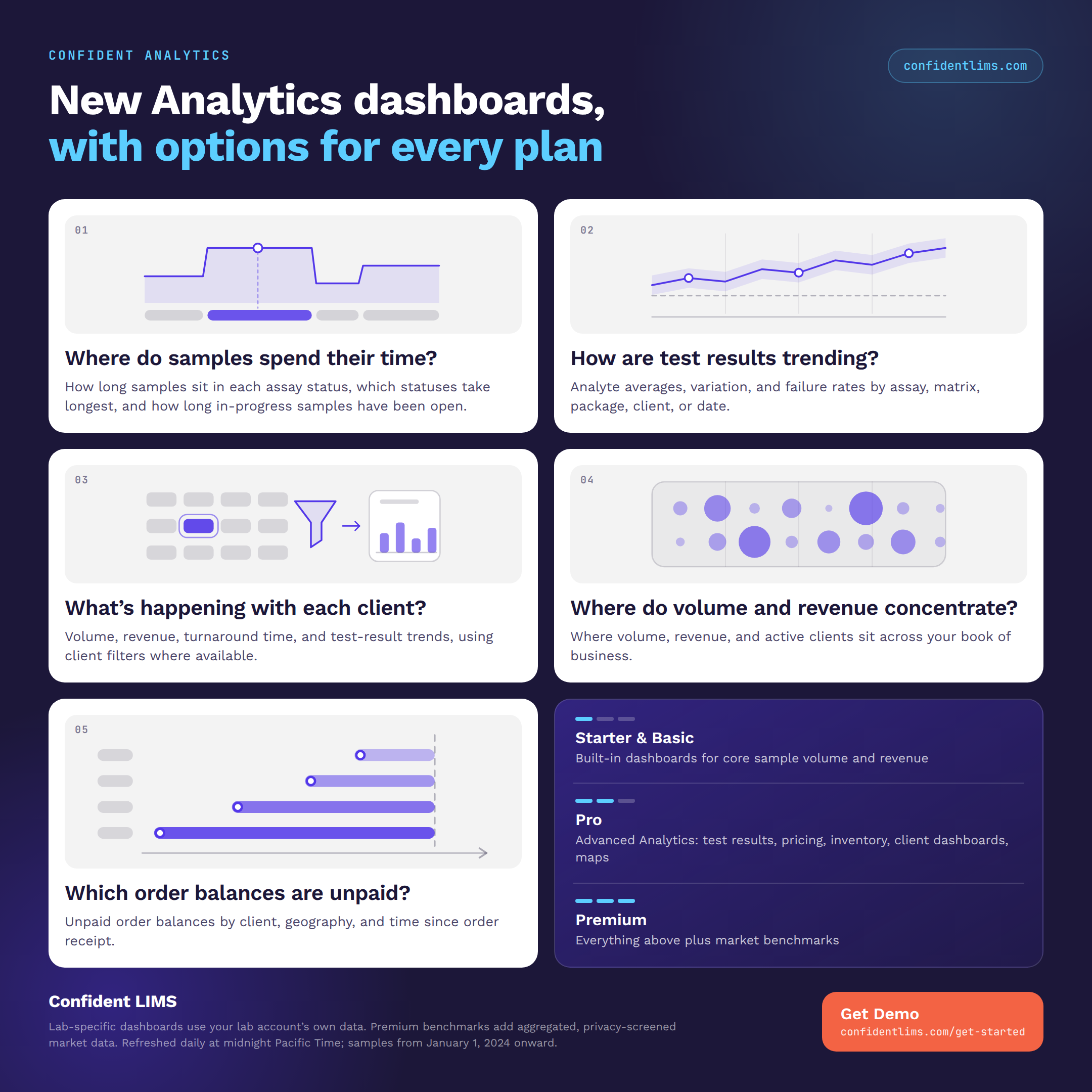
New Analytics dashboards in Confident LIMS: turnaround time, test-result trends, client activity, benchmarks, unpaid order balances. Options on every plan.
READ MORE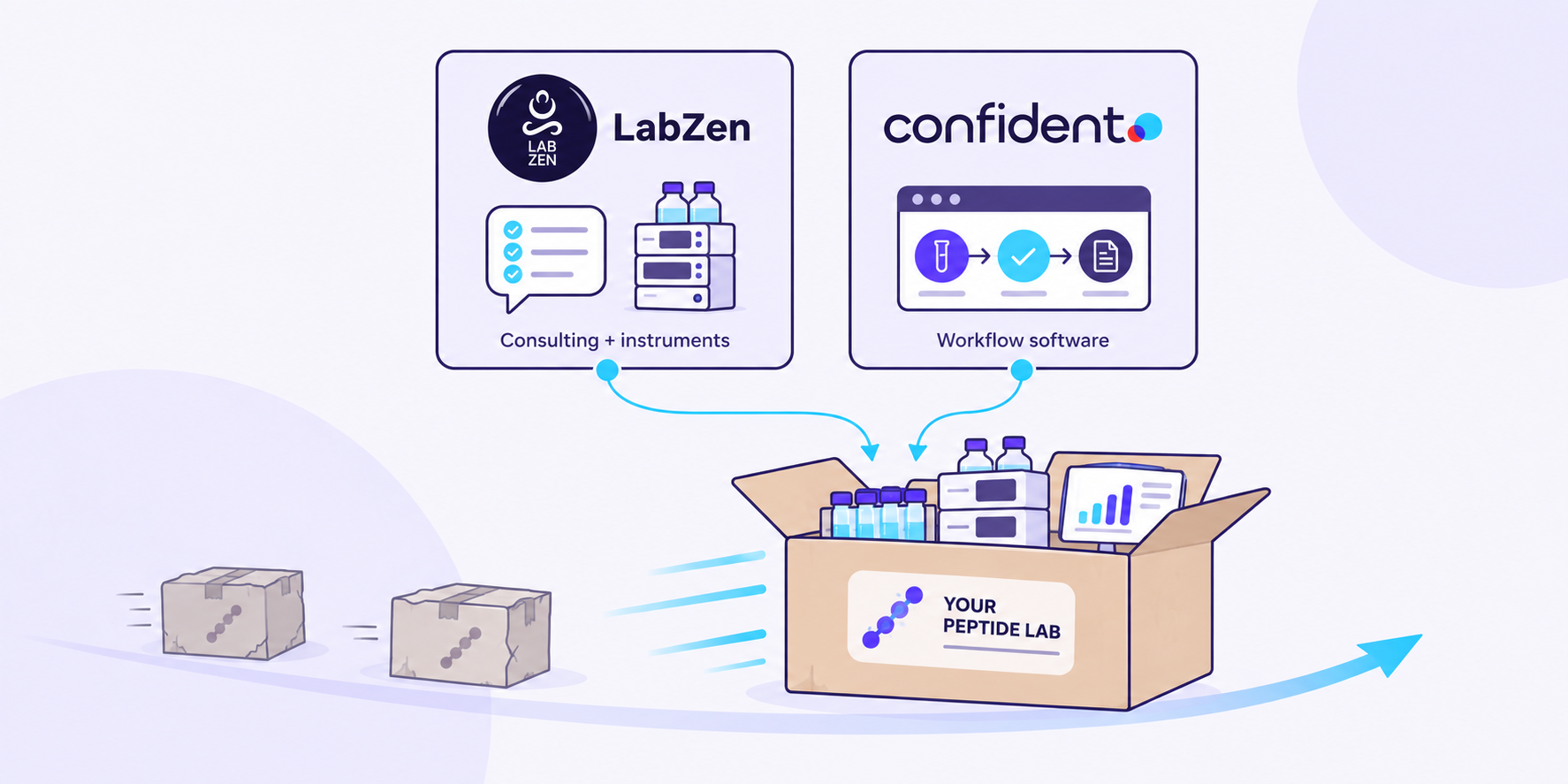
Confident LIMS and Lab Zen are partnering to help peptide labs plan instruments, methods, and the sample-to-COA workflow together.
READ MORE
Analytics dashboards are now live in the Confident Client Portal: free Volume dashboards for everyone, plus 19 advanced dashboards for Client Pro.
READ MORE


