New Lab Analytics Dashboards, With Options for Every Plan
New Analytics dashboards in Confident LIMS: turnaround time, test-result trends, client activity, benchmarks, unpaid order balances. Options on every plan.
READ MORE
Configurable vs customizable LIMS: one means settings, the other means code. See why the difference decides your go-live timeline and ongoing cost.


Most labs don't lose months to a hard implementation. They lose months to the wrong word in the contract.
🎧 Prefer to listen? Here's the full audio version of this article:
When a vendor says a LIMS is "customizable," that usually means changing source code to fit your lab. When they say it's "configurable," that means adjusting built-in settings — no code, no developer. That single distinction is the best predictor of whether you go live in weeks or wait two quarters. Configuration gets a regulated lab running in 2-6 weeks. Customization can stretch to 6, 12, even 24 months, and every upgrade afterward risks breaking what you paid to build.
If you're evaluating a LIMS, this is the question to settle before you talk about features. Here's what the two words actually mean, why the gap shows up in your timeline, and what to ask a vendor before you sign.
The industry mostly agrees on the definitions. Configuration means adapting a LIMS — a Laboratory Information Management System — using built-in tools: forms, fields, workflows, templates, and rules you adjust through settings. Customization means writing or modifying source code to create behavior the platform doesn't ship with.
Consultants who implement these systems for a living draw the line the same way. CSols describes customization as modifying or writing source code, versus configuration that uses built-in tools (csolsinc.com). Autoscribe makes the operational point: configuration can be handled by lab staff, while customization requires a developer, plus retesting and documentation every time the code changes (autoscribeinformatics.com).
So far, so clear. The problem is what most articles leave out — they define the words but never connect them to the two things a lab actually feels: your timeline and your ongoing cost.
Think of configuration as building with lego blocks. The pieces already exist and snap together in known ways. You arrange them to match your lab, and if your process changes next year, you rearrange them. Nothing has to be invented.
Customization is more like pouring concrete. You get exactly the shape you asked for, but it's set. Changing it later means breaking it and pouring again — usually with the same developer who poured it the first time.
That's why configuration goes live in weeks and customization runs in quarters. A configurable platform ships the building blocks; your team assembles a working lab. Confident labs go live in 2-6 weeks because test packages, Certificates of Analysis (COAs), workflows, and compliance rules are set up through configuration, not code. Custom development starts from a blank file: specs, build, test, fix, revalidate, repeat. Even vendors built on legacy architecture now argue that configuration beats customization on speed and maintainability (thermofisher.com).
The timeline gap isn't a detail. For a lab waiting to onboard clients or open a new testing line, six months of implementation drift is six months of revenue you don't get back.
A custom build has two price tags. The first is the implementation you can see. The second is the one that follows you for the life of the system.
Custom code has to be maintained by someone who understands it. One widely cited LIMS pricing analysis quotes a lab's own review of a heavily code-based system: it "would require a full time developer constantly adding new functionality." The same analysis puts custom integration work at roughly $150–250 per hour, with major integrations landing between $25,000 and $100,000 each (scispot.com). That's not a one-time line item. It's a standing dependency.
The trap is subtle. Heavy customization can feel like a perfect fit on day one. Then a method changes, a regulator updates a limit, or you add a new test — and the only person who can adjust the system is the developer who built it, or a services team billing by the hour. QBench notes the pattern plainly: custom code tends to mean longer timelines, higher costs, and vendors who push implementation past the date they promised (qbench.com).
Configuration avoids the standing dependency. When your lab can adjust a workflow without a developer, change is a Tuesday-afternoon task — not a project. CloudLIMS makes the cost-of-ownership case directly: configurations are more cost-effective and simpler to maintain than custom code (cloudlims.com).
Here's the same scenario in both worlds. Say you need to add a pesticide panel to your cannabis testing menu, or stand up a new EPA method for a water contract. In a configurable LIMS, you build the test package, map the analytes and limits, set the COA template, and you're testing — your own staff, days not months. In a code-centric system, that's a change request: scoped, quoted, developed, retested, and revalidated before a single sample runs. Same goal. Very different week.
For a regulated lab, custom code carries a cost that has nothing to do with money: revalidation.
When software behavior comes from code, changing that behavior means changing the code — and in a quality system, changed code means you revalidate. Every tweak can trigger a documentation and testing cycle to prove the system still does what your SOPs and accreditation require. Under standards like ISO 17025 and programs like NELAP, you have to show your data path is controlled and traceable. The more of that path that lives in bespoke code, the more surface area you have to revalidate every time anything moves.
Configuration changes the math. When you adjust settings inside a validated platform rather than rewriting its logic, the scope of what you have to re-check is smaller and more predictable. You're still responsible for validating your configuration — no platform makes compliance automatic — but a configurable system helps you comply with ISO 17025, NELAP, and state programs like METRC without turning every change into a code-validation project.
That's the quiet advantage of "configurable." It's not just faster to launch. It's faster to keep compliant, audit after audit.
Honesty matters here, because "configurable" isn't a magic word and customization isn't always wrong.
Some labs really do need behavior no platform ships with — a proprietary algorithm, an instrument with no standard connector, a one-off integration into an internal system that exists nowhere else. In those cases, custom development is the right tool, and a good vendor will tell you so instead of forcing a square peg through a configuration screen.
The goal isn't zero customization. It's to cover as much of your lab as possible through configuration, and reserve custom work for the genuinely unique 5% — eyes open about the maintenance and revalidation that come with it. A platform that handles 95% through configuration leaves you a small, well-understood custom footprint. A platform that needs code for routine changes leaves you carrying a developer indefinitely.
The trouble starts when "we'll just customize it" becomes the answer to ordinary requests that configuration should have covered. That's the timeline killer — and it's avoidable.
Vocabulary is easy to claim and harder to prove. These questions surface the truth before it's in the contract.
A vendor who's genuinely configurable answers these without flinching. A vendor selling customization dressed up as flexibility will reach for "it depends." That hesitation is your answer.
🎧 Short on time? Here's the podcast brief:
Configuration adapts a LIMS using built-in tools — settings, forms, fields, workflows, and templates — without changing code. Customization modifies or writes source code to create behavior the platform doesn't ship with. Configuration can usually be handled by lab staff; customization requires a developer.
Because the building blocks already exist. Your team assembles a working lab from pre-built components instead of waiting for code to be specified, developed, tested, and validated. That's why configurable platforms go live in weeks while custom builds run in quarters.
Usually, yes. Custom code has to be maintained by someone who understands it — an in-house developer or a vendor services team billing by the hour. One pricing analysis cites a lab review describing a code-heavy system that "would require a full time developer constantly adding new functionality" (scispot.com).
Generally, because it avoids the standing cost of developers and per-hour services for routine changes. Industry sources note configurations are more cost-effective and simpler to maintain than custom code (cloudlims.com). Customization still makes sense for genuinely unique needs.
With a configurable platform, yes — that's the point. Adding a test, adjusting a workflow, or updating a COA template is a settings change your team makes directly. With a code-centric system, the same task becomes a developer change request.
The configurable-versus-customizable question isn't academic. It's the difference between a lab that's testing samples next month and one still waiting on a development backlog next quarter. Configuration keeps change in your hands — fast to launch, simple to maintain, and far easier to keep compliant.
Confident is configurable by design: test packages, COAs, workflows, and compliance rules adapt through settings, not proprietary code. That's why labs go live in 2-6 weeks and keep moving without a developer on call.
See it mapped to your lab's workflows. Get Demo
Let's share!
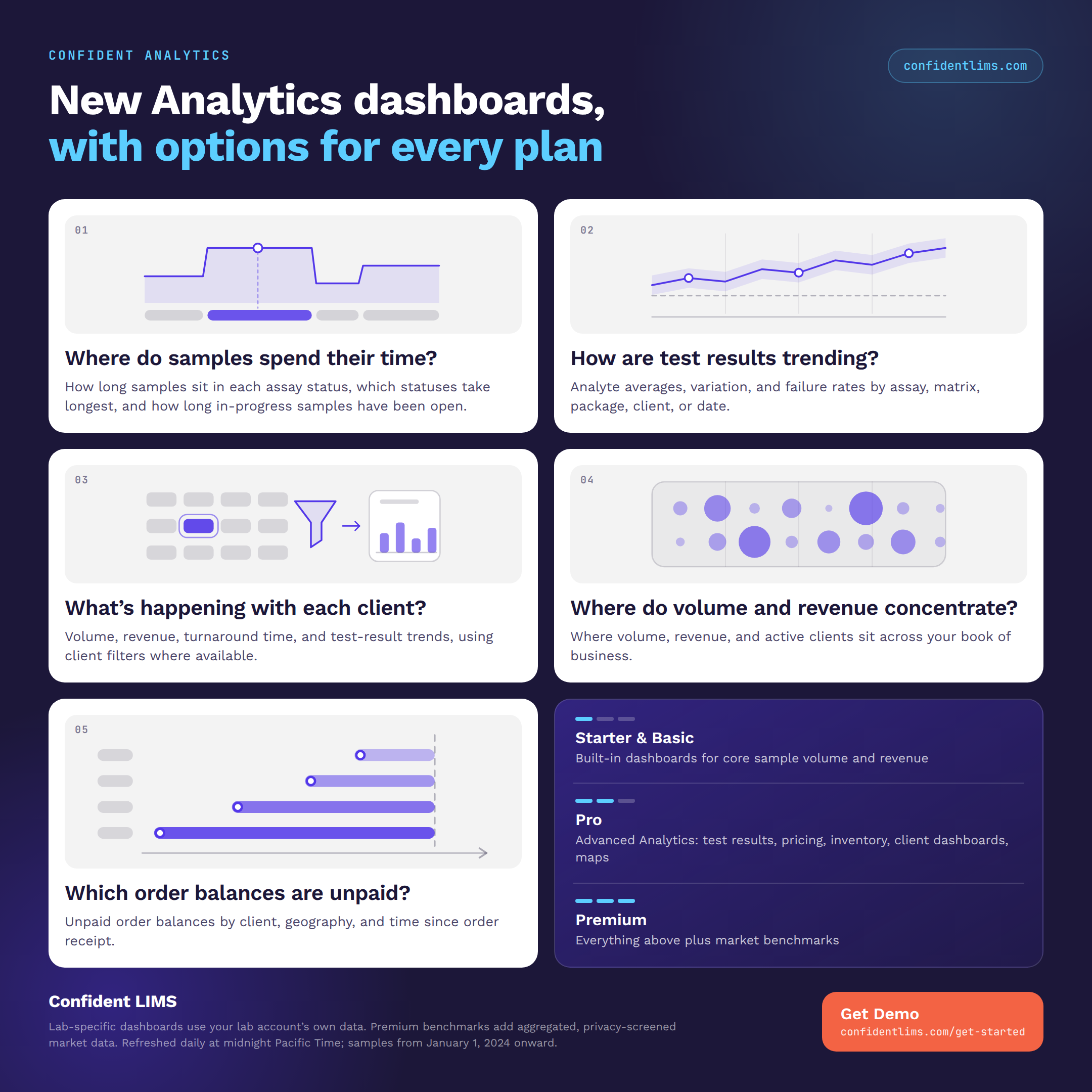
New Analytics dashboards in Confident LIMS: turnaround time, test-result trends, client activity, benchmarks, unpaid order balances. Options on every plan.
READ MORE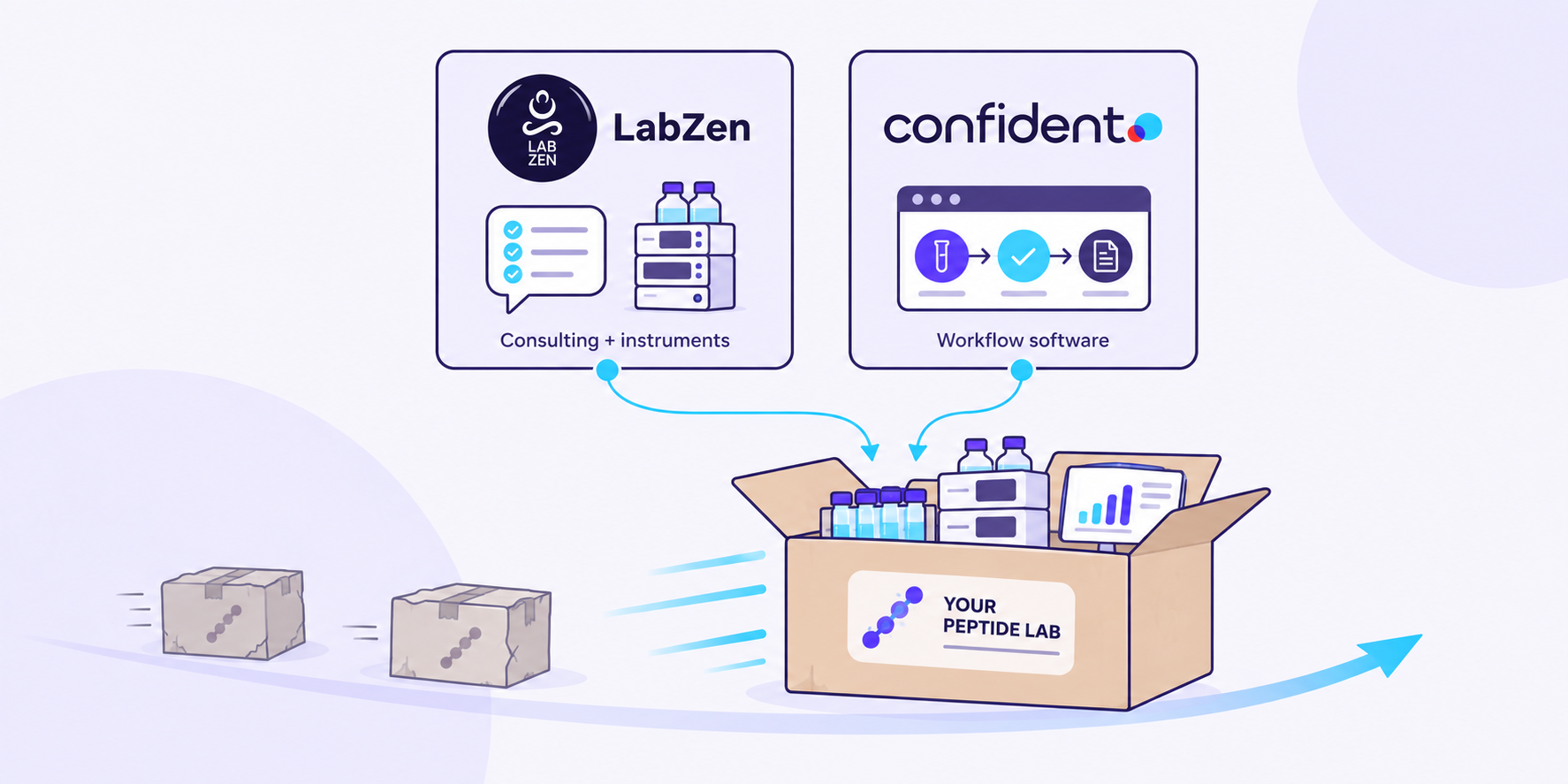
Confident LIMS and Lab Zen are partnering to help peptide labs plan instruments, methods, and the sample-to-COA workflow together.
READ MORE
Analytics dashboards are now live in the Confident Client Portal: free Volume dashboards for everyone, plus 19 advanced dashboards for Client Pro.
READ MORE


