New Lab Analytics Dashboards, With Options for Every Plan
New Analytics dashboards in Confident LIMS: turnaround time, test-result trends, client activity, benchmarks, unpaid order balances. Options on every plan.
READ MORE
A vendor-neutral checklist and weighted scorecard for regulated labs evaluating LIMS vendors — including an honest read on where Confident doesn't win.

Most LIMS evaluations go sideways in the first week. Not because the buyer picks the wrong vendor — because they start by comparing features instead of deciding what their lab actually needs. Feature lists are written by vendors. Your requirements aren't.
🎧 Prefer to listen? Here's the full audio version of this article:
So here's the other approach: a one-page requirements brief, seven evaluation categories that hold up across regulated industries, and a weighted scorecard you fill in yourself. We'll also tell you where Confident doesn't win. A checklist that only flatters one vendor isn't a checklist.
Choose a LIMS by writing a one-page requirements brief first, then scoring every vendor against the same weighted criteria: industry fit, configurability, compliance coverage, integration, user experience, support and time-to-value, and cost transparency. Weight each criterion Essential, Preferred, or Optional before you sit through a demo. The system with the highest weighted score wins — not the vendor with the best presenter.
Before you look at a single screenshot, answer one question: what business problem are we solving?
Write the answer down on one page. It should cover your lab's size and number of sites, the regulatory environment you operate in (ISO/IEC 17025, NELAP/TNI, 21 CFR Part 11, Metrc or BioTrack, FSMA), your sample types and turnaround commitments, and the systems this has to talk to — instruments, accounting, CRM.
Then split those requirements into three buckets, because vendors will happily blur them:
That one page becomes your internal source of truth. Every demo gets measured against it, and when two people on your team disagree about a vendor, you'll find the disagreement is usually about the brief, not the software.
A LIMS built for your lab type saves you months. A cannabis lab in New York needs Metrc reporting and automatic flagging when a result crosses an action limit. An environmental lab needs method-level QC, batch structures, and reporting that a TNI assessor recognizes on sight. A food lab needs allergen and pathogen workflows with traceability that survives an FSMA 204 request.
Ask vendors to show you their configuration for your industry, live. Not a slide about it.
Can your team change a workflow, add a field, or adjust a report template without filing a ticket?
This is the single criterion with the longest financial tail, and it's covered in its own section below. For now: look for no-code workflow changes, permission controls your QA manager can administer, and a template library you can start from.
No vendor is "21 CFR Part 11 certified." There is no such certificate. What a LIMS can do is help you comply — through audit trails, electronic signatures, versioned records, and access controls that your own validation demonstrates.
So ask for the artifacts: validation documentation, IQ/OQ/PQ protocols, and a live walkthrough of the audit log with a record being changed in front of you. If those only appear after you sign, that tells you what you need to know.
Your LIMS sits in the middle of a stack. Ask specifically:
"We can integrate with anything" is not an answer. Ask what's already built.
Your analysts will use this system every hour of every shift. Count the clicks to log a sample during the demo. Ask whether a bench tech can work from a tablet next to the instrument. Ask how a client retrieves a COA.
A system your team quietly avoids is a system you paid for twice.
Support consistently ranks at or near the top of what lab buyers say they care about — and it's the criterion most scorecards underweight. Ask for the actual commitments: response time, resolution time, whether onboarding is measured in weeks or quarters, and who owns your migration.
Confident's numbers here are fast onboarding, same-day support response, and 1–2 day resolution. Ask every vendor on your list for the equivalent, in writing.
You're scoring the three-year cost, not the first invoice. Ask what's included and what isn't: implementation, data migration, additional users, sandbox environments, API access, report templates, and what an upgrade costs. If pricing is "custom quote only" with nothing published, you'll spend the evaluation negotiating instead of comparing.
Here's the part most buying guides skip. Weight the criteria before the demos, while you're still objective.
Give each line one of three weights:
Then score each vendor 0–5 on how well they meet it, and multiply. Same scale, same scorer, every vendor.
Two rules keep this honest. First, no more than four Essentials — if everything is essential, nothing is. Second, score from what you saw in the demo, not from the proposal.
These two words get used interchangeably in sales calls. They describe opposite futures.
Configurable means your team changes workflows, fields, templates, and permissions themselves, through the interface, with no code. The change takes an afternoon. It survives the next upgrade.
Customizable means a developer writes code against your instance. The change takes a scoping call, a quote, and a release window — and then you own that code forever, including revalidating it every time the platform updates.
Most legacy LIMS deployments that turned into 18-month projects got there through customization. Ask the question directly: when our QA manager needs a new field on the COA next quarter, who does the work, how long does it take, and what does it cost? The answer predicts your third-year invoice better than the price sheet does.
Bring these to every demo. Ask them in the same order, and write down the answers:
That last one is the most useful question in the list. Every honest vendor has an answer.
We built Confident for regulated, high-throughput labs, and the framework above is roughly how our own customers evaluated us.
Where we score well: configurability without code, a Client Portal your clients actually use to pull their COAs, fast onboarding rather than a multi-quarter project, same-day support response with 1–2 day resolution, and one platform across cannabis, environmental, food and beverage, nutraceutical, and cosmetics testing rather than a separate system per vertical. Today more than 20,000 scientists run over 5 million samples a year through Confident, inside a 15,000+ client network, and labs moving off manual handoffs typically work 2–3x faster.
Where we don't win: if your lab needs deeply bespoke, code-level modifications to match a process you intend to keep exactly as it is, a customizable platform with a developer team attached will fit you better than we will. We're configurable by design, and that's a trade-off, not a superpower. Score it as one.
🎧 Short on time? Here's the podcast brief:
What should I look for when choosing a LIMS?
Start with industry fit, configurability, compliance coverage, integration, user experience, support and time-to-value, and cost transparency. Weight them against your own requirements brief before you see a demo, so the evaluation measures your lab's needs rather than the vendor's feature list.
What's the difference between a configurable and a customizable LIMS?
A configurable LIMS lets your team change workflows, fields, and templates through the interface, with no code. A customizable LIMS requires a developer to write code against your instance, which means scoping, cost, and revalidation every time the platform updates.
How do I score and compare LIMS vendors objectively?
Assign each criterion a weight — Essential (8 points), Preferred (4), or Optional (2) — before demos begin. Then score each vendor 0–5 on each criterion and multiply by the weight. Same scale, same scorer, every vendor.
What questions should I ask a LIMS vendor during a demo?
Ask them to log and release a sample end to end in your industry's configuration, change a report field live, open the audit log on a changed result, name the instruments already connected, state onboarding and support commitments in contract terms, and describe what the product doesn't do well.
What are red flags when evaluating LIMS software?
Custom-quote-only pricing with no three-year model, validation documentation or audit-log demos promised only after signing, support with no SLA in the contract, no sandbox before commitment, and bundled modules you'll never use.
The right LIMS isn't the one with the longest feature list. It's the one that scores highest against the requirements you wrote down before anyone started selling.
Build your brief, set your weights, then run every vendor — including us — through the same scorecard. If you'd like to see how Confident scores against your criteria rather than ours, Get Demo.
Let's share!
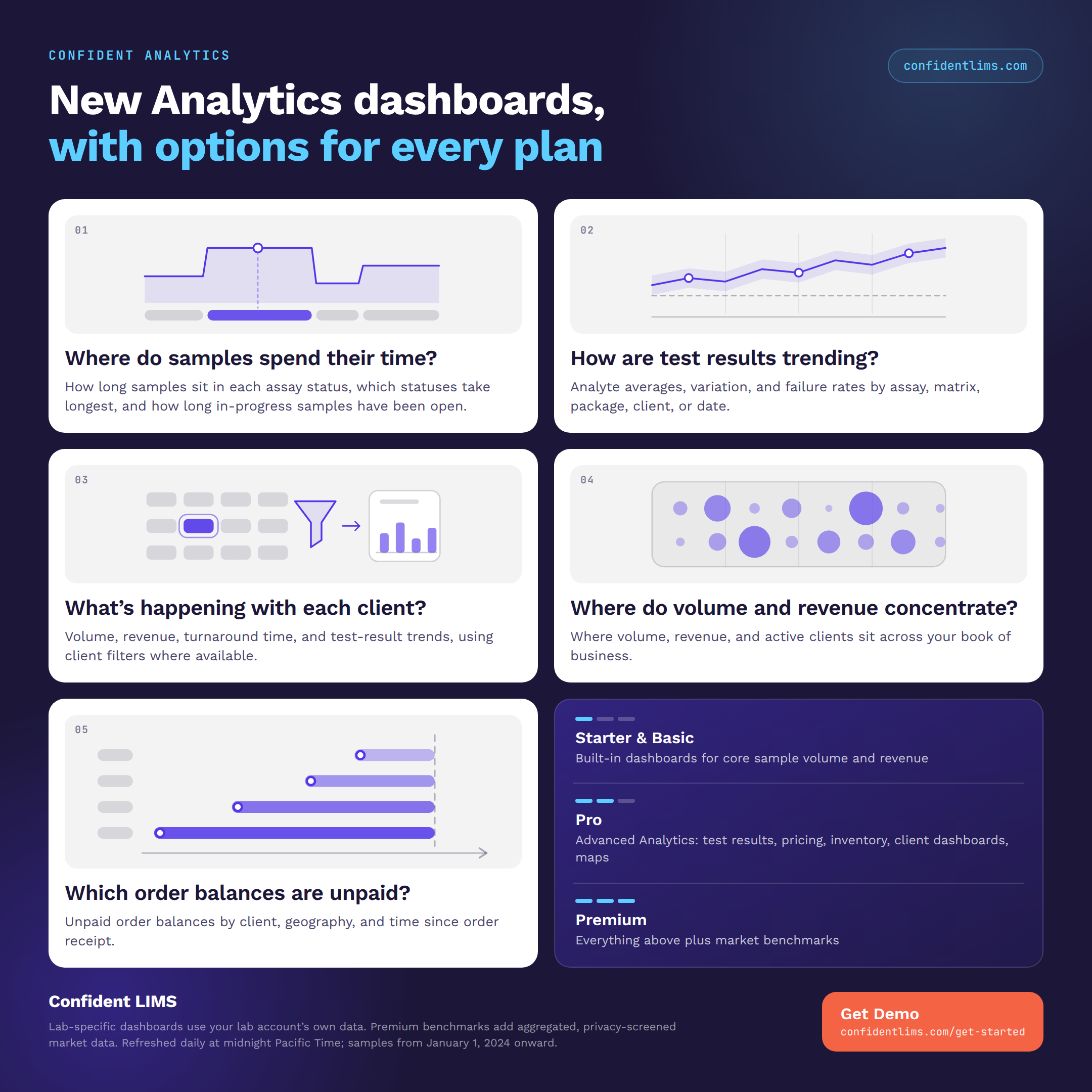
New Analytics dashboards in Confident LIMS: turnaround time, test-result trends, client activity, benchmarks, unpaid order balances. Options on every plan.
READ MORE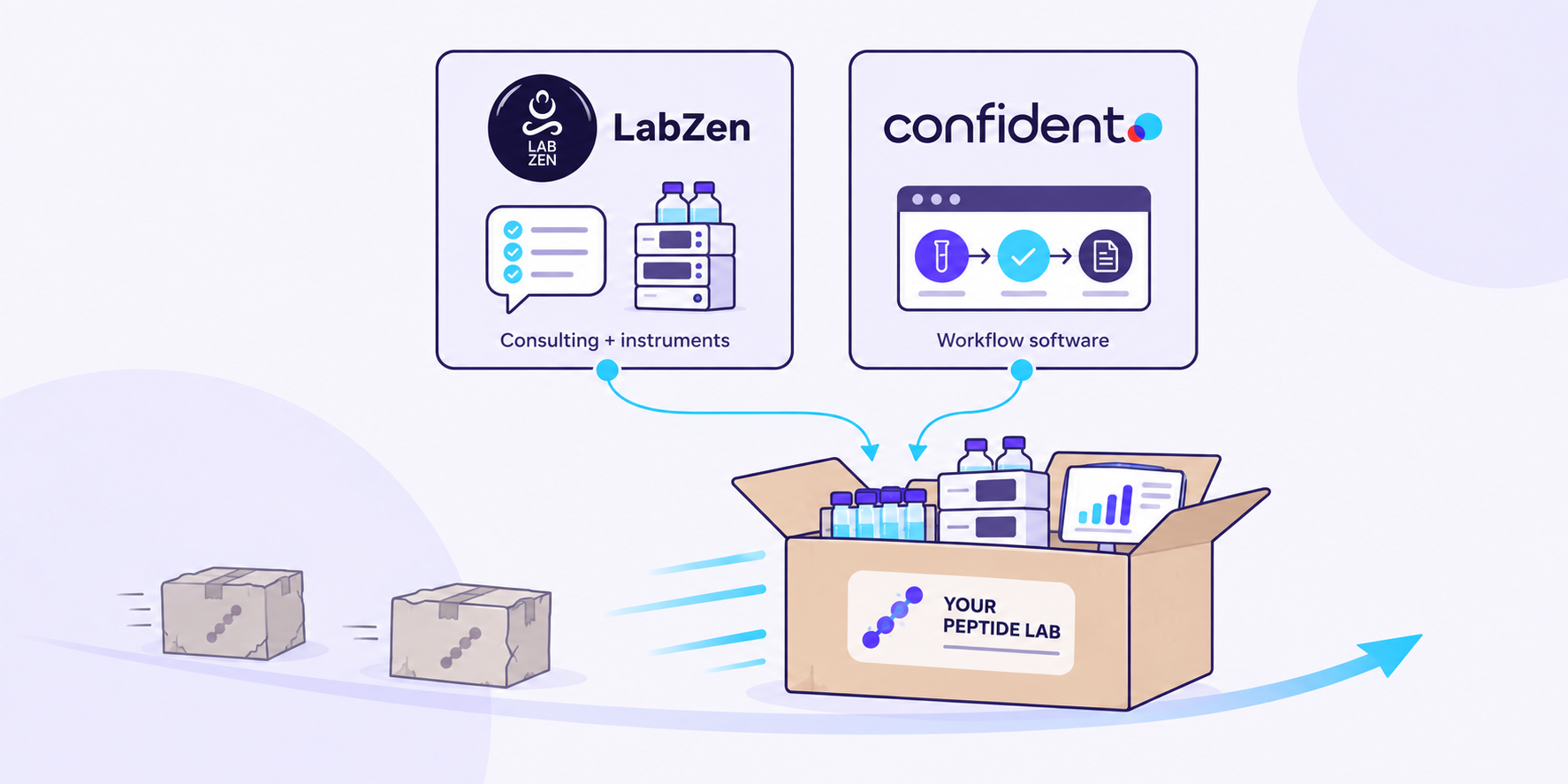
Confident LIMS and Lab Zen are partnering to help peptide labs plan instruments, methods, and the sample-to-COA workflow together.
READ MORE
Analytics dashboards are now live in the Confident Client Portal: free Volume dashboards for everyone, plus 19 advanced dashboards for Client Pro.
READ MORE


