New Lab Analytics Dashboards, With Options for Every Plan
New Analytics dashboards in Confident LIMS: turnaround time, test-result trends, client activity, benchmarks, unpaid order balances. Options on every plan.
READ MORE
Accreditation rarely fails on chemistry. It fails on retrieval. Here's what the TNI standard expects your records to prove — and how to make that a by-product of running the lab.

Most environmental labs don't lose accreditation because the chemistry was wrong. They lose it because nobody could find the record that proved the chemistry was right.
🎧 Prefer to listen? Here's the full audio version of this article:
NELAP accreditation is granted by state-run accreditation bodies against the TNI Environmental Laboratory Sector Standard. As of October 2026, the 2016 TNI standard is the version labs are assessed against — there is no adopted "2024 standard," though a revision to V1M2 (Quality Management System Requirements) went out for comment in 2026. A LIMS supports accreditation by making the evidence an assessor asks for — custody, SOP versions, analyst competency, calibration history, PT results, and a complete audit trail — retrievable on demand instead of reconstructed before the visit.
The acronyms get used interchangeably, and that's where confusion starts.
TNI — The NELAC Institute — is the non-profit that writes and maintains the standard. NELAP — the National Environmental Laboratory Accreditation Program — is the accreditation program built on that standard. NELAC is the predecessor body that TNI replaced. Your lab is accredited by a NELAP-recognized accreditation body, usually a state agency, which assesses you against the TNI standard.
So nobody is "TNI certified." Labs hold NELAP accreditation, assessed against TNI requirements. That distinction matters when you're writing proposals for government clients who read the language closely.
Labs are assessed against the 2016 TNI Environmental Laboratory Sector Standard. That has been the working version for years, and it remains so as of this writing in October 2026.
What's moving: TNI posted draft revisions during 2026 for comment, including V1M2 (Quality Management System Requirements). Drafts in a comment period are not requirements. Watch them, don't rebuild your quality system around them. TNI publishes the standards actually in force on its standards page — check the date there before you cite a version in a bid document.
If a consultant or a vendor tells you there's a "2024 TNI standard" you need to comply with, ask them to point at the adoption notice. There isn't one.
Walk into any assessment and the pattern repeats. The analysis was sound. The instrument was calibrated. The analyst was trained. And then the assessor asks for the training record that was current on the day that sample ran, and the lab spends forty minutes in a filing cabinet.
TNI blends ISO/IEC 17025 management and technical requirements with rules specific to environmental testing. Underneath nearly all of them sits the same question: can you produce the evidence, tied to the sample, on demand?
That's a data architecture problem. Spreadsheets and shared drives can hold the information. What they can't do is bind it to the sample, timestamp it, lock it against silent edits, and hand it back in the order an assessor asks for it.
Here's where a system purpose-built for regulated testing earns its keep. Each of these is a place where labs commonly take findings — and a place where configurable software closes the gap.
Custody has to be unbroken and documented from collection through disposal. Done on paper, every handoff is a chance for a missing initial or an illegible time.
In Confident, custody events are captured as they happen — who, when, what condition, which cooler, which temperature. The record builds itself as the sample moves. When an assessor pulls a sample ID, the custody history is already there.
TNI expects the SOP in use to be the approved current version, and expects you to show which version was in force when a given result was produced.
Store methods and SOPs in the LIMS, tie each test to its approved version, and restrict editing to the people who own that method. The point isn't locking people out. It's that a result from March points at the March SOP, not at whatever's current today.
Initial and continuing demonstration of capability is one of the most common finding areas, because it's one of the hardest to keep current on paper.
Track certifications, training dates, method authorizations, and DOC records against each analyst. Let the system flag what's expiring before it expires. The goal is that no analyst is ever running a method they're not currently authorized for — and that you can prove it retroactively.
Calibration records, QC acceptance criteria, corrective actions, maintenance intervals. All of it has to connect back to the results produced on that instrument during that window.
Logging calibrations in the LIMS rather than in an instrument-side binder means the link survives. Pull a result, see the calibration that stood behind it.
Proficiency testing isn't a side task — it's a condition of staying accredited for each field of proficiency testing you hold. Labs get caught when a PT study is late, a corrective action never closed, or nobody can find the report from two cycles ago.
Track PT studies, results, and corrective actions in the same system that holds the routine work, and the question "are we current on every FoPT we claim?" becomes a screen rather than a project.
Every entry, edit, and approval logged with user, timestamp, and reason. No silent overwrites. This is where data integrity requirements shared with 21 CFR Part 11 and ISO 17025 do real work: if a result changed, the record shows who changed it, when, and why.
An assessor who can navigate the trail without a chaperone is an assessor who finishes early.
Most labs run accreditation as a sprint. Six weeks out, someone starts assembling binders, chasing training records, and reconciling calibration logs. It works, more or less, and it costs the lab a quarter of a quality manager's year.
The alternative is boring in the best way: the evidence accumulates as work happens, so assessment week is a retrieval exercise rather than a reconstruction project. That's the shift worth engineering for — and it's the honest case for putting a LIMS at the center of a quality system rather than beside it.
Confident is configurable for NELAP workflows — your methods, your QC rules, your report formats — and onboarding is fast, not the multi-quarter implementation labs have learned to dread. Confident helps you comply with the recordkeeping and data integrity expectations in the TNI standard. It does not make your lab accredited; your accreditation body does that, and the work is still yours.
A stormwater client drops nine samples. Custody is captured at receipt — condition, temperature, receiving analyst. The samples route to VOCs by EPA 8260 and metals by ICP-MS, each pointing at its current approved SOP. The system checks that the assigned analysts hold live authorizations for those methods, and that the instruments are inside their calibration windows. QC flags fire on an out-of-spec surrogate recovery, holding the batch for supervisor review before anything reaches a report. The final report carries method references, QC flags, analyst IDs, and a linked custody record — and goes to the client portal rather than an email attachment.
Nobody did anything "for the audit." The audit file is a by-product of running the lab.
Labs on Confident process more than 5M samples a year across regulated verticals, supported by a network of 15,000+ clients and more than 20K scientists — which is to say these patterns are well-worn, not theoretical.
🎧 Short on time? Here's the podcast brief:
What is NELAP/TNI accreditation?
NELAP is the National Environmental Laboratory Accreditation Program. Labs are accredited by NELAP-recognized accreditation bodies — typically state agencies — and assessed against the TNI Environmental Laboratory Sector Standard.
Which version of the TNI standard is in force?
The 2016 TNI standard, as of October 2026. A draft revision to V1M2 was posted for comment during 2026, but drafts in a comment period are not requirements. Confirm the current version on TNI's standards page before citing it.
What's the difference between NELAC, NELAP and TNI?
TNI writes the standard. NELAP is the accreditation program built on it. NELAC is the predecessor organization TNI replaced.
How does a LIMS help with NELAP accreditation?
By making required evidence retrievable instead of reconstructable: custody, SOP versions in force at time of analysis, analyst authorizations, calibration history, PT results, and a complete audit trail — all bound to the sample.
What are FoPT tables?
Fields of Proficiency Testing: the analyte-method-matrix combinations for which a lab holds accreditation and must demonstrate ongoing proficiency through PT studies.
Pick the finding that cost you the most time at your last assessment — usually competency records or custody gaps — and fix the retrieval problem for that one thing first. Accreditation readiness compounds; you don't have to buy it all at once.
If you want to see what continuously audit-ready looks like against your actual methods and your accreditation body's checklist, we'll walk through it with you.
Let's share!
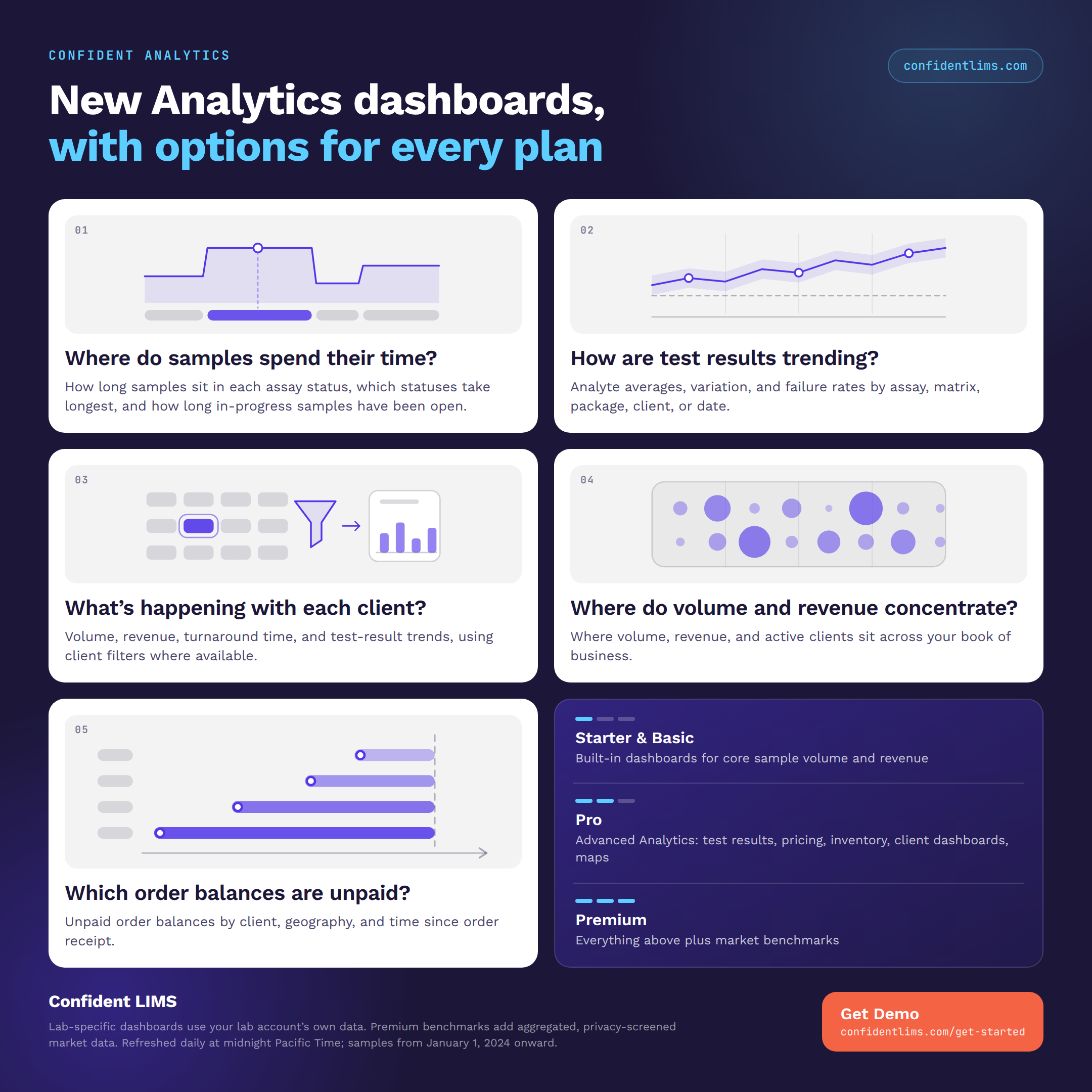
New Analytics dashboards in Confident LIMS: turnaround time, test-result trends, client activity, benchmarks, unpaid order balances. Options on every plan.
READ MORE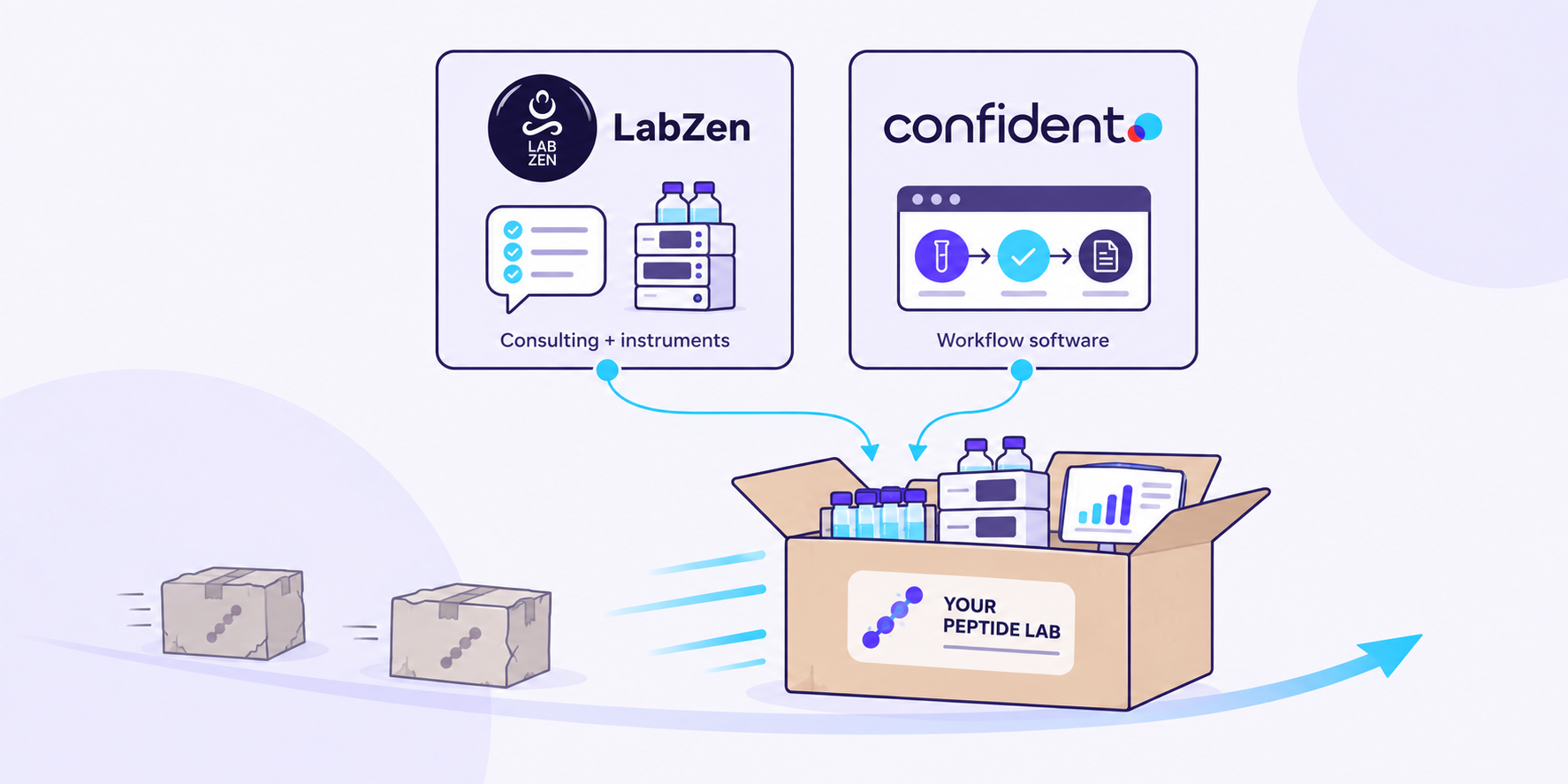
Confident LIMS and Lab Zen are partnering to help peptide labs plan instruments, methods, and the sample-to-COA workflow together.
READ MORE
Analytics dashboards are now live in the Confident Client Portal: free Volume dashboards for everyone, plus 19 advanced dashboards for Client Pro.
READ MORE


